
The strange economic history of flax – and why its ending matters now
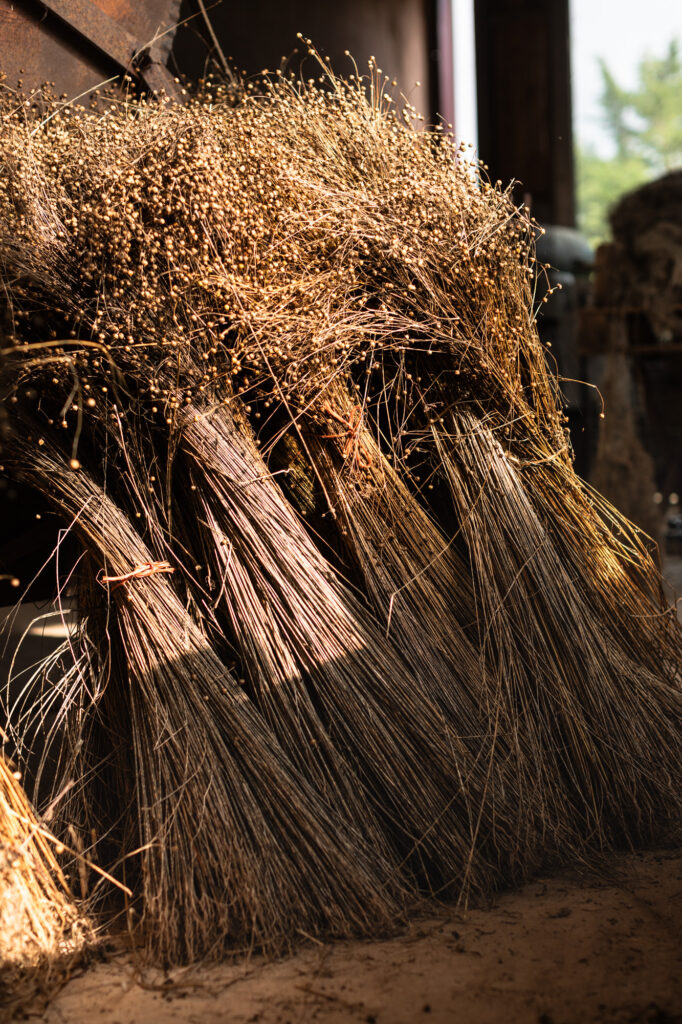
"Linen forgot where it was reared."
The Opposite of Apocalypse by Abby Oliveria, written for Mallon Farm
This line in Abby Oliveira’s poem stops us every time. It’s a poet’s phrase, but it also happens to be an exact description of what economists spent a century puzzling over. How did the country that built the greatest linen industry in the world end up importing almost all the flax it spun?
It’s a strange chapter in the history of Irish linen — it holds a lesson for anyone trying to revive local, sustainable industry today.
Flax was never a “marginal” crop
We often tend to imagine flax as a quaint sideline. It wasn’t. The geographer W.J. Smyth, in his study of flax cultivation, analysed the industry through “staple theory.” This is the idea that a primary crop can generate forward linkages into processing industries, creating layers of secondary wealth. His conclusion: linen was the single most successful crop in all of Irish economic history.
By 1780, the combined value of exported linen, yarn and flax exceeded the value of exported cattle, meat, dairy and grain combined. Flax was not a hobby. It was the foundation of the most sophisticated regional economy on the island.
The small farmer’s crop
The success of flax and linen began on small plots of land. Two-thirds of the 55,000 people in the Linen Board’s 1796 scheme had grown just one rood of flax; 90% had sown an acre or less. As late as 1904, three-quarters of all Irish flax was still grown in plots under two acres.
An 1862 report explained why it worked: it was “essentially the small farmer’s crop, sown by himself, and cleaned, pulled, steeped, and even scutched by his wife and children.” It was an efficient and carefully balanced system: families supplied low‑cost labour, the flax crop reacted quickly to shifts in market prices, and the scutching was carried out in winter (this was when the streams were at their strongest and the small water‑powered mills scattered across Ulster could run at full force). In 1875, within just five miles of Cookstown, thirty of these scutch mills were operating.
The paradox at the heart of Linenopolis
Then spinning industrialised. From the 1820s, wet spinning developed in Belfast. It needed capital, factories, steam power and a concentrated urban workforce. It could produce fine yarn at a speed hand-spinning could never reach. By 1874, there were 43 textile mills in Belfast; between 1873 and 1914 the city was the largest linen manufacturer on earth, and earned its nickname: Linenopolis.
However, as Linenopolis grew, something broke. The industry outgrew its own fields. On the eve of the First World War, 85% of the flax used to make Irish linen was imported from Belgium, Holland and Russia. A century earlier, that figure had been 27%.
Smyth’s verdict is devastating in its precision: as Irish linen reached world dominance, it became an industry importing most of its raw material and exporting most of its product. “The originating link with the agricultural sector was virtually severed.” Through its own success, Irish flax had been dethroned by the very industry it created. The mill prospered, but the farms grew something else.
There was a human cost too. The factory wage – paid to individuals with no stake in the raw material and no connection to the field – replaced the household income the whole family had once made across many months from a crop grown on their own land. And the mills themselves were brutal places — flax dust and hot, damp air drove epidemic tuberculosis. By 1891, nearly half of Belfast’s linen workers who died had tuberculosis, and 90% of them were under forty.
Why the ending matters now
Here is the part that changed how we think about our own project. The cottage economy — small-scale, rational, ecologically sound, deeply rooted in the landscape — was not destroyed because it was inefficient. It was destroyed by specific historical conditions: rural outmigration removed the cheap family labour; farm consolidation swallowed the small holdings; and the industry chose to import its flax rather than grow it at home. Those were circumstances of a moment — not permanent laws of economics.
The circumstances have now changed. Outmigration is no longer the force it was, and the case for local, traceable natural fibre hasn’t been stronger in a century. The premium for fine linen, made from Irish flax (ranked third in the world by value in 1907), hasn’t vanished; if anything it’s rising as synthetics face growing regulatory pressure and consumer rejection.
A report from the 1911 government warned that it seemed “a rather serious thing to allow to go out of cultivation a crop for the successful production of which this country has many advantages.” This report was written as the industry was dying ; it reads very differently now that someone is trying to grow it again.
Not Linenopolis — something older
We’re not trying to rebuild Linenopolis. The spinning mill we hope to open at Hillmount wouldn’t employ 600 people. The plan is for it to employ a small team of four on an operating day, whilst opening to the public, and spinning yarn from flax grown a few miles up the road in County Tyrone.
That wouldn’t be nostalgia at all. It would be the cottage economy — scaling by replicating rahter than centralisation. And if we can make it work, the forward linkages Smyth described — the value added and retained at each stage of processing — could flow again with the wealth spread across many hands instead of concentrated in a few.
None of this is guaranteed; much of it rests on the support and funding that we are now working to secure. But flax is already growing again in County Tyrone. Linen is beginning to remember where it was reared.
The history in this piece draws on W.J. Smyth’s study of Irish flax cultivation and the research gathered in the Linen Workers business plan. Come and see the revival for yourself.
The Linen Workers Restoration Project is subject to funding. This post describes what we hope to do, not a confirmed programme.